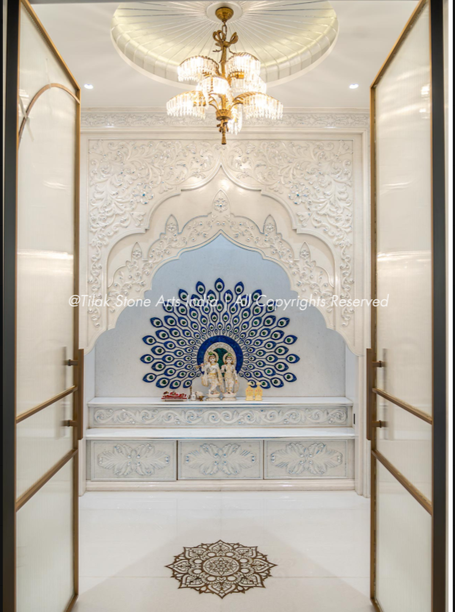
A white home temple marble can look like three different pieces of stone between breakfast and dinner. A catalogue photo shows it under one fixed light, at one fixed moment. Your home works differently, with windows, passing clouds and a sun that keeps moving across the temple. So the same white may look creamy at dawn, slightly bluish at noon and set a warm gold by evening. Some owners notice this only weeks after installation, and it can feel as if the stone changed when, in truth, the light did.
None of this points to a flaw in the stone. A white home temple marble reacts to daylight in a fairly predictable pattern, and a bright stone like the Vietnam White Marble shows each shift clearly. Once you know the pattern, picking the wall, the window side and the evening lamps gets much easier. Here is why the hours matter.
Why a White Marble Temple Changes Colour Through the Day
Two things happen at once. First, daylight itself shifts colour as the sun moves. Morning light leans warm, noon light turns cooler and bluer, and evening swings warm again. Lighting engineers measure this in kelvin, where lower numbers look warmer. Daylight sits near 3,000 K around sunset and can climb toward 10,000 K under a clear noon sky.
Second, light does not just bounce off marble. It slips a short way into the stone, spreads out inside and leaves again at a nearby point. Graphics researchers at Stanford who measured this effect noted that it softens shadows and plays down small bumps. That gives white marble its gentle glow, and it also explains why fine carving can look blurry in flat light.
See also: Your Complete Guide to the Master of Architecture Program at Dar Al-Hekma University
Early Morning Light on a Vietnam White Marble Temple
Sunrise is probably the most flattering hour for white marble. Through an east-facing window, the low sun reaches the temple at a shallow angle instead of from above. That angle drops tiny shadows into every carved petal and border, and the detail you paid for becomes easy to see. The warm tone adds a faint ivory cast, which suits a quiet first prayer.
Vastu guidance lines up with this. It favours the north-east corner for a pooja room so the space draws in morning sun, with the person praying facing east. Of course, not every flat has a spare north-east corner, and a temple on another wall may simply lean more on lamps.
Midday Light and Glare on a Polished Marble Mandir
By noon, the scene changes. The sun climbs high, less direct light reaches the temple, and the room fills with even brightness. Shadows inside the carving shrink, and the stone can look flatter than it did at breakfast. The cooler daylight pushes the marble toward a crisp, slightly bluish white, which some people call pure, and others find a bit cold.
A polished surface looks shiny and reflective, which means a patch of direct sun can bounce straight back as glare. Picture a temple set opposite a large balcony door. At breakfast it looks perfect, yet by afternoon a bright streak may sit across the face of the murti for about an hour.
Oddly, noon is the most honest hour too. It shows the true white of the stone, with no warm tint hiding anything. Check these points around midday:
- Does direct sun land on the temple itself, or only near it?
- Can you see a bright reflection on the murti from where you sit?
- Does the white look clean to you, or slightly grey in the shade?
Late Afternoon and Sunset Tones in a Pooja Room
Later in the day, warm tones return to the room. Low light from a west window can give the marble a honey shade. Thin carved edges may glow faintly, since light passes through them more easily than through thick sections. This hour can feel especially devotional, perhaps because it arrives around the time families light the evening diya.
Still, strong western sun can feel harsh on a face-level murti for a short while. Vastu advice usually places pooja room doors and windows on the east or north side, which keeps this late glare mild. Even so, a west-facing room can work well if the temple sits slightly out of the direct beam.
Evening Aarti and Built-In Lighting for a White Marble Temple
After sunset, your lamps do all the work. This is where a beautiful temple can quietly lose its charm. Warm-white bulbs usually fall between 2,700 and 3,000 K, while light above 5,000 K reads as cool, bluish white. Under cool tube lights, white marble can look stark and clinical, which is rarely the mood anyone wants at aarti.
Next Steps Before You Choose a Spot for Your Marble Temple
Before you finalise the design, spend one ordinary day watching the exact wall you have in mind.
- Stand there around 7 am, noon, 5 pm and after dark, and take an unfiltered phone photo each time.
- Sit where you usually pray and look for glare from that exact spot.
- Switch on the lamps you already use and see what colour they throw on something white.
- Share the photos with your temple designer. Pictures show far more than a written description.
A marble temple usually stays in one place for decades. After all, you will stand before it every morning and evening, so one day spent watching the light first is a small effort.